



By Dr. Philip Attebery, President • BMA Theological Seminary
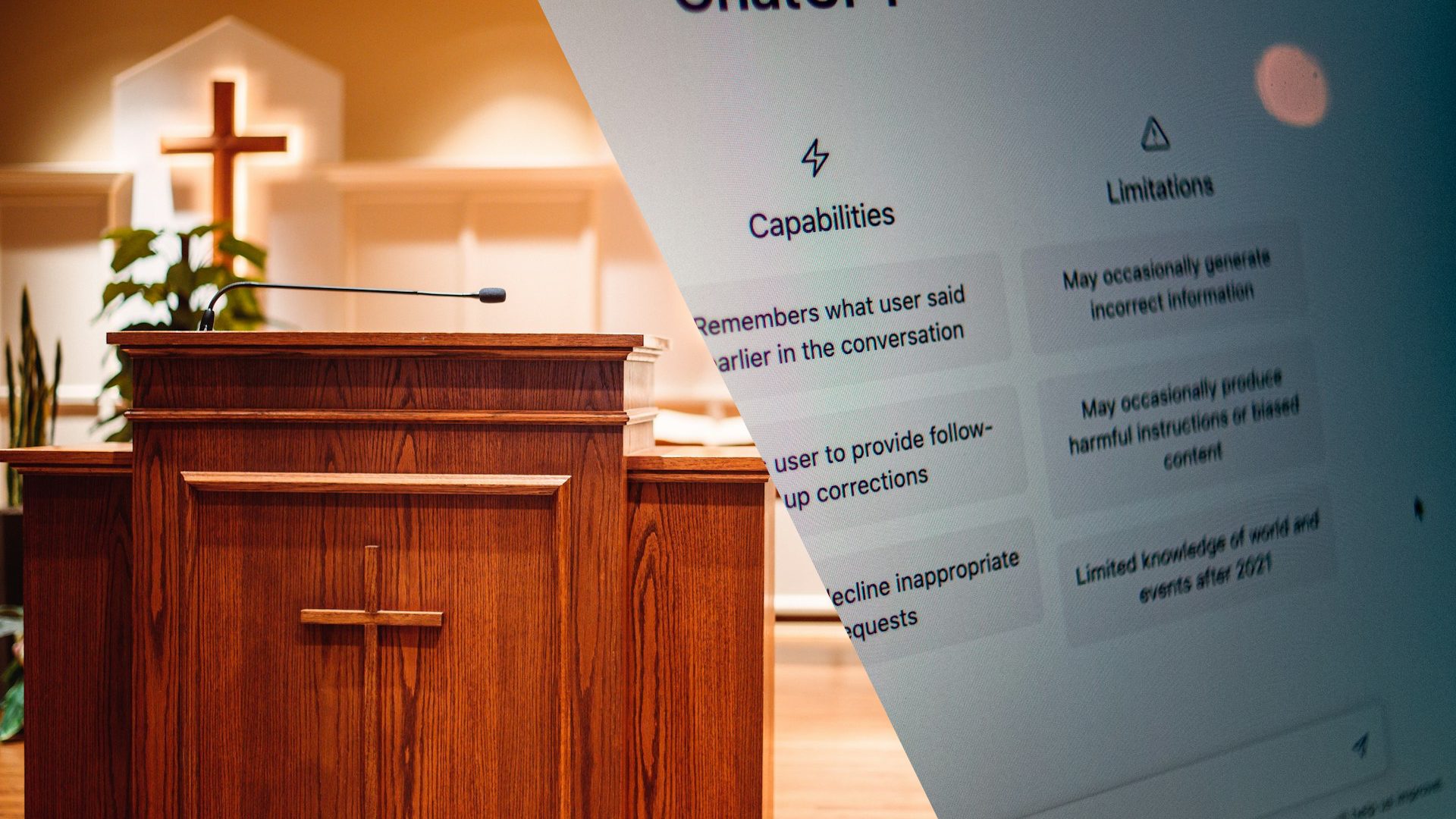
Someone recently asked, “Can the BMA Seminary provide pastors with guidance on the use of Artificial Intelligence (AI), especially for sermon preparation?”
BMA Seminary faculty recently identified two basic types of AI. “Assistive” AI seems to be acceptable for use in sermon preparation. Such AI can assist a pastor in finding related Bible passages, researching the background of a biblical text, discovering the meaning of biblical terms and finally checking the grammar of his sermon. “Generative” AI creates a sermon for the pastor. This seems to be unacceptable. Generative AI does more than assist the pastor. It does all the work for him. Why is this unacceptable? There are ethical, cognitive and biblical reasons to consider:
• Ethical Reasons — Ethically, think about the “byline.” Church bulletins often indicate that the sermon will be delivered “by” the pastor. Congregants rightly assume that the pastor named has researched and prepared the sermon presented “by” that pastor. If I present a sermon generated by AI, or copied from another preacher, I cannot ethically declare that I delivered a sermon prepared “by Philip Attebery.”
• Biblical Reasons — Biblically, the apostle Paul directed Timothy, “Study to shew thyself approved unto God, a workman that needeth not to be ashamed, rightly dividing the word of truth” (II Tim. 2:15). This passage applies to any preacher or presenter of God’s Word.
Paul wrote the word “study” as a command. The word means to be diligent, eager and to exert oneself. This alone renders the use of Generative AI unacceptable in sermon preparation. A preacher who uses AI to generate his sermons cannot honestly say he has been biblically diligent to exert himself in sermon preparation.
Two results should come from diligent study. First, a preacher should “shew” or present “thyself approved unto God.” A congregation of listeners may accept AI-generated sermons, but God is the ultimate determiner of acceptability. II Timothy 2:15 makes it clear that God desires to accept the man who has diligently exerted himself. A preacher cannot honestly say that he has shown himself to be a diligent student, of whom God approves, by using AI-generated sermons.
The second result of diligent study is to be an unashamed worker who rightly divides the Word of Truth. The word “workman” indicates labor and work! The word “unashamed” implies that there is no need to be ashamed. The phrase “rightly dividing” means to handle something correctly and to cut straight. A preacher cannot honestly say that he has worked hard, correctly handled God’s Word and has no reason to be ashamed when using AI to generate sermons.
• Cognitive Reasons — Cognitively, the use of AI may cause significant and long-term decrease in a person’s brain function. According to the abstract of the June 2025 report entitled, Your Brain on ChatGPT: Accumulation of Cognitive Debt when Using an AI Assistant for Essay Writing Task, conducted by researchers from the Massachusetts Institute of Technology (MIT), the results of their study on participants’ AI use “demonstrate… a likely decrease in learning skills”and that AI users“performed worse than their counterparts”who did not use AI.
According to the MIT report, users of AI are 60% more productive overall; however, their “cognitive load” needed for real learning is reduced by 32%. Pastors are expected to learn biblical truths and content as they prepare sermons. AI hinders such learning.
Although Assistive AI is acceptable for finding Bible passages, the MIT report warns that “as users increasingly depend on search engines for fact-checking and accessing information, their ability to remember specific content may decline…” This can potentially be a problem. For example, hiding God’s Word in your heart helps you avoid sin, not simply having quick access to His Word.
Conclusion
Those currently using AI to generate sermons should consider the findings and questions asked above. It is incredibly difficult to see how a preacher can obey the command and attain the status required of II Tim. 2:15 if using AI to generate sermons. Having served as a bi-vocational pastor at times during my ministry, I can understand the temptation to use helps in generating sermons. In the past, some pastors have simply plagiarized “their” sermons by using messages discovered on the Internet, in a book or other formats. Today, using generative AI may appear to remove some of the stigma because it does not directly copy another preacher’s message. However, it clearly violates the ethical and biblical guidance presented in this article. For more on this, visit the BMA Seminary’s blog on AI and Sermon Preparation at bmats.edu/2025/09/03/ai-and-sermon-preparation.
