



We’ve walked this prophetic road map from Scripture one step at a time. From Jesus’ warning about armies surrounding Jerusalem to the coalitions forming on the map, we’ve looked at how the Southern bloc will strike first, and the Northern flood will follow. We’ve followed Daniel’s blow-by-blow as the campaign intensifies. And now, as the armies move into place and Jerusalem groans under their weight, the camera zooms in, not on the nations, but on the man who leads them — the so-called Antichrist.
But if you’ve grown up in church, looked into any end-time content or even read my articles, that name might betray you. Because while “Antichrist” has become the most common title for this figure, it’s not the most accurate, and it’s certainly not the most Biblical. In fact, the word only appears five times in all of Scripture, and never in Daniel, Revelation or Jesus’ own teaching on the end of the age. When John uses the term, he’s not talking about a future tyrant at all. He’s talking about false teachers who deny that Christ came in the flesh. Not a warlord, not a king, not a man surrounded by tanks and treaties, but a deceiver of the church. The Antichrist label might speak to spirit, but it doesn’t capture the spear.
Because the Bible doesn’t describe the final enemy of God’s people as a mysterious global politician or digital-age cult leader, it doesn’t point west toward Silicon Valley, Brussels or the United Nations. It points north, revealing something far more grounded and dangerous.
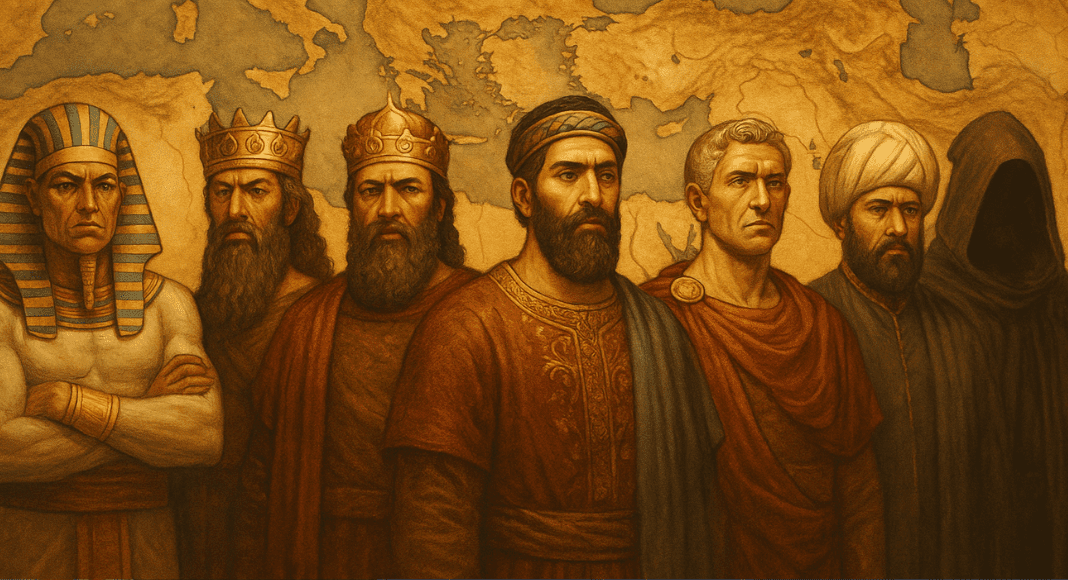
He is a king, or at least the modern equivalent, a warrior and a Gentile tyrant who rises out of a long legacy of empires that have crushed Israel under their boots, from Egypt to Babylon, Persia to Greece and Rome to the Islamic caliphates. He is the last in a line of kings who seek to destroy the covenant people in the covenant land.
And the prophets give him many names — the Little Horn, the Desolator, the Man of Sin, the Worthless Shepherd, the Beast, the Prince to Come, Gog and — perhaps most specifically in Daniel’s final vision — the King of the North.
This is the man who commands the red wave in Daniel 11. After the Southern bloc — likely led by Egypt and its Arab partners — strikes, the King of the North floods south with overwhelming power. He doesn’t just defeat his enemies. He desecrates the land. He moves through nations like a whirlwind. He enters “the Beautiful Land” (Israel) and seizes Jerusalem. He desecrates the temple. He breaks the covenant. He seats himself between the seas and the glorious mountain. And then he unleashes horror.
We’ve seen his shadow before. In Antiochus Epiphanes, the Seleucid king who outlawed Torah, slaughtered Jews and defiled the temple with pig’s blood. But that was only the preview, and Daniel’s final vision is the main act.
Here’s where it gets even more sobering. He’s not just some new face. He may very well be Gog. The name Gog first appears not in Ezekiel, but in Numbers 24. Balaam, of all people, prophesies that a ruler will rise to crush Israel, but that a king from Jacob will rise to crush him. Gog is a pattern. A prototype. A title passed down like Pharaoh or Caesar. And Ezekiel picks it up, describing Gog of Magog as a military leader from the far north, joined by Persia (Iran), Put (Libya), Cush (Sudan), Gomer, Togarmah, Meshech and Tubal (regions tied to modern Turkey and Central Asia). Together, they surround Israel and march on Jerusalem. They fall on the mountains of Israel, just as the King of the North meets his end.
We’ve been trained to spiritualize this figure. To look for barcodes, microchips and smooth-talking globalists. But the Bible refuses to do that. It pins him to a place, wraps him in military power, and aims him like a missile at the people of God.
This final tyrant is not a metaphor. He’s not a symbol of bad doctrine or corrupt politics. He’s a storm, and he’s coming for Israel.
This is why Jesus warned His followers to watch for the desecration of the holy place. This is why Paul said the “man of lawlessness” would take his seat in the temple. This is why Revelation calls him the Beast. Because his authority is satanic and his power is global, but his aim is regional. His target is Jerusalem. His purpose is to break the covenant God made with Abraham, Isaac and Jacob — to silence the worship, desecrate the temple and devour the remnant.
He will rise. He will rage. And for a time, it will look like he has won. But he won’t. Daniel says plainly: “He shall come to his end, and no one will help him” (Dan. 11:45 NKJV). Revelation describes fire from the mouth of the King and a sword from the sky. The mountain splits and the tyrant is crushed. The King of Kings takes the throne, not just in Heaven, but in Zion.
This is the man we must watch for — not a hologram or a symbol but a man of war — a regional tyrant and the final Gentile hammer before the kingdom comes.
And when he rises, the prophets want us to know what to look for. They gave us his names. They drew his map and told us the end from the beginning. He is the King of the North —the Final Gentile Tyrant.
Consider how the Biblical foundation of the regional conflict is central to the end times. It grounds the Scriptures. It grounds the narrative of the Bible. It gives reason for a Messiah and a Messianic Kingdom.
When we bring the one modern Christianity has deemed the Antichrist into this regional conflict, we see what the Old Testament prototyped repeatedly — there is one final Gentile tyrant ruler that will rise up and come against Israel.
