



We’ve been walking this map for months now — through Daniel’s battlefield, across Ezekiel’s valleys — tracing every movement of the northern and southern coalitions as they collide in the heart of the Middle East. We’ve seen the final Gentile tyrant rise from the north, driving his campaign southward until he plants his throne in the Beautiful Land. And we’ve said from the start, the End Times is first and foremost a regional war centered in Israel. It is not a shadowy, everywhere-at-once global takeover. The prophets don’t paint a vague world ruler pulling the strings of every nation from some ivory tower. They paint a warlord, rooted in a place, commanding armies, overrunning real borders, obsessed with Jerusalem.
But the End Times isn’t just a war that stays regional. It spills over, not because the Antichrist suddenly runs the globe, but because war in the Middle East never stays in the Middle East. Scripture points to sensational ways in which the End Times spills to the whole world — deception, Christian persecution and the supernatural plagues. But there is also a very “earthy” real spill over that comes from the heart of the regional conflict narrative. This regional war spills into the world’s shipping lanes, rattles its markets and jolts its alliances. The Bible’s details make this plain. Unlike most End Time movies and novels, not every nation is on the side of the final tyrant. Not every person bends the knee. Some resist. Some stand back. Some only care when their trade is in danger. And all of it — every protest, every naval maneuver, every economic shock — becomes part of the countdown to Jerusalem’s siege.
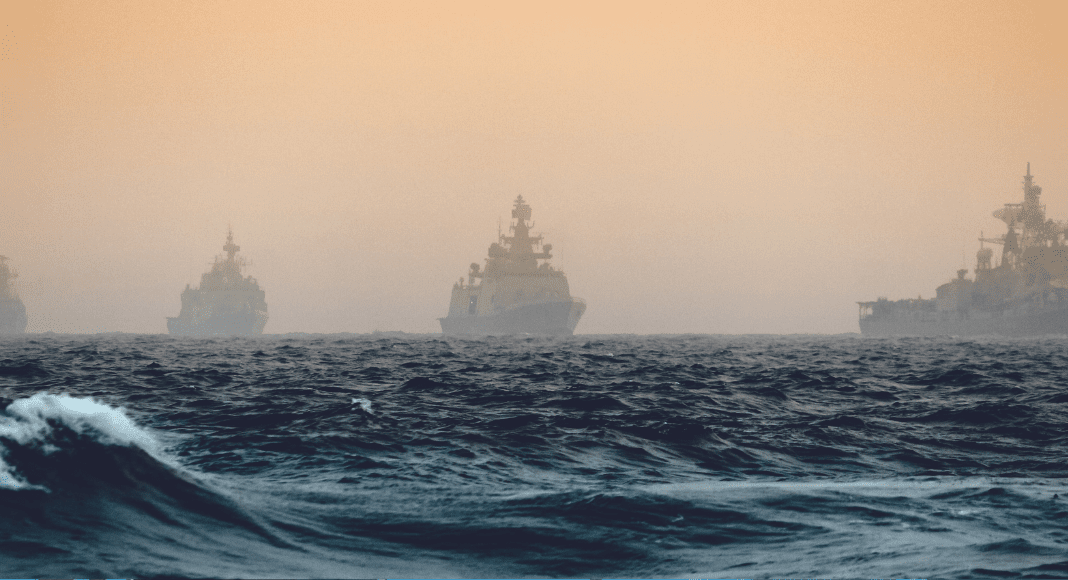
And again, like everything we’ve looked at, this is heavily revealed in the Text. Daniel gives us one of these moments in a single line: “ships of Kittim” come against the northern king. Kittim was Cyprus in its earliest usage, but by the prophets’ day, it had come to mean the western maritime powers — the far side of the Mediterranean. Daniel places them at a pivot in the war, a sudden intrusion from the West.
It’s a check, a flash of steel on the horizon — a Western carrier group in the Eastern Mediterranean, a blockade threat in the Suez, warships shadowing the shipping lanes. The northern king is pressured, pushed to adjust. But he’s not overthrown.
Ezekiel adds to this overflow. In chapter 38, as Gog — the northern leader and likely the Antichrist — brings his coalition down on Israel, voices rise from beyond the battlefront. Sheba and Dedan, the old names for the trading powers of the Arabian Peninsula, speak alongside the merchants of Tarshish, the great far-western seafaring traders, and all her “young lions” or “villages” — the outposts and partner states tied to her trade network. They aren’t sending armies. They’re sending words: “Have you come to take spoil? Have you gathered your army to carry off plunder?” It’s the language of merchants, not soldiers. They care about resources, about goods, about shipping and markets, in modern terms: oil flows, export contracts and shipping insurance. They don’t intervene. They watch, they calculate and they speak their disapproval because the war threatens their bottom line.
And then Ezekiel pushes the camera further out, into chapter 39. After God strikes the northern king’s forces, He says: “I will send fire on Magog and on those who dwell securely in the coastlands.” The “coastlands” are the far maritime shores — the distant nations tied into the world’s trade routes. They weren’t in the fight. They didn’t land troops in Israel or march behind Gog’s banner. But they feel the fire anyway. They stand against Israel by doing nothing.
And here’s the part most End Times charts never account for: this isn’t the whole world united under the Antichrist. The prophets show nations resisting him — naval powers confronting him, merchants questioning him, distant economies reeling from him. They show some neutral, some hesitant and some only waking up when their trade suffers. The typical picture of a one-world government with every leader saluting the Beast flattens the nuance Scripture actually gives us. Yes, he wields enormous power. Yes, his reach grows. But his war has opponents, skeptics and bystanders — and God records them. That means the story is not just about his control, but about how the world reacts as the war spills over.
And the spillover is the key. It begins with Western warships in the Eastern Mediterranean. It spreads with Gulf traders and far-western merchants lodging their protests. It escalates when the coastlands feel the fire, when the war’s ripples have moved from Jerusalem’s gates into the vaults and trading floors of cities across the sea. All the while, the core stays the same. This is still about the armies in Israel, the siege of Jerusalem and the covenant land under assault. The wider world is pulled in through the cracks — by water, by trade, by energy.
Even Jesus hinted at this sequence. Before the city is surrounded, He said, “nation will rise against nation, and kingdom against kingdom.” (Matt. 24:7 NIV) Not a single global empire, but a world already fractured — ethnic strife, border wars, alliances in flux. That is the climate into which the northern and southern coalitions collide. By the time the Antichrist storms into Jerusalem, the world’s systems are already frayed. One regional war, in the wrong place, at the wrong time, is enough to spill crisis into every capital.
And so, the map holds. The center is Israel. The campaign is fought between real nations in her neighborhood. But the edges of that map are wet with the sea lanes of Kittim, the trade routes of Tarshish and the harbors of the coastlands. The prophets saw them. They gave them names. And they told us what would happen when the war touched them. The Antichrist won’t have every nation’s loyalty. But his war will have every nation’s attention.
So, the end times will engulf the world, but it still stems from that regional center.
