



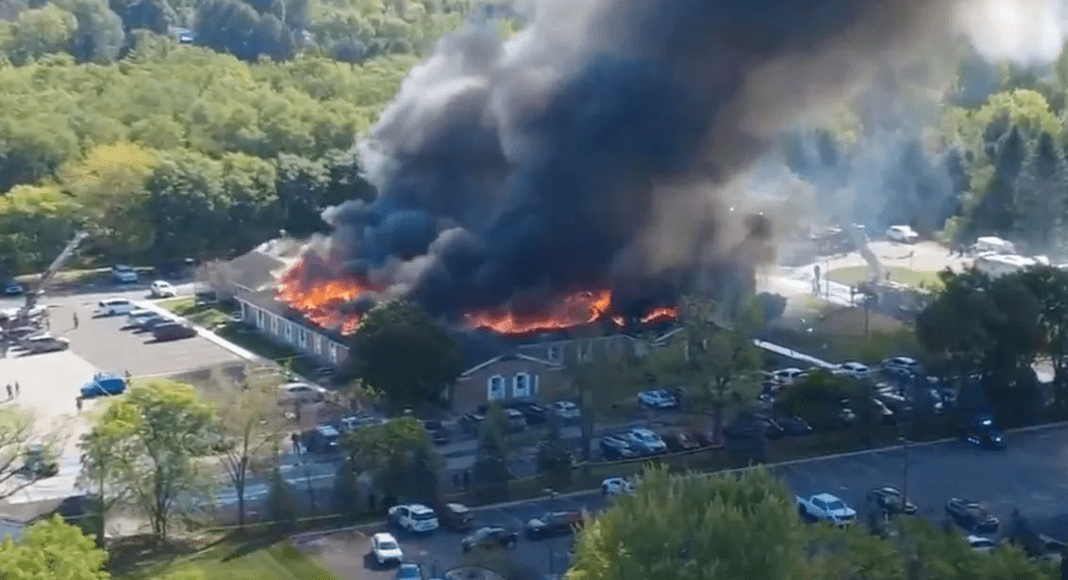
The headlines keep coming — Michigan, Texas, Charleston, and so on. We pray, we grieve, we hold vigils, and then Sunday comes again. Even though there are years in between, that doesn’t mean there isn’t an uptick and more frequency of violence against churches. Since 2000, there have been 379 recorded violent incidents connected with churches in the US, resulting in 487 deaths. Before the 1999 Fort Worth shooting, you’d have to go back to 1980 to find a shooting in a church.
The increase and the threat are apparent, and with every attack, something deeper shifts. The sanctuaries that once felt like havens now carry the faint echo of risk. The world feels thinner around the edges, and the question slips quietly into our hearts: “What would we do if it happened here?”
I’ve been asking that question for years, not as a doomsayer, but as a pastor who believes the Lord often prepares His people through what He allows us to see. It’s a pattern that is evident throughout Scripture and history. One of the most evident examples is the series of smaller Babylonian deportations that preceded the ultimate Babylonian captivity of Israel.
God warns us. This has been on my heart since 2010, and I’ve discussed it extensively through Stand Firm Ministries, from 2016 to COVID-19, but in the last several years, it’s fallen off my radar. That doesn’t mean it should be off it, though. This is a threat that is not going away for churches in America, and if we’re wise, we’ll prepare our hearts and our habits before the storm hits our doors.
Many of us have already made changes in our Sunday gatherings in terms of security. We may have security teams. Those who carry each week. We might pay more attention to the locking of the doors. That’s great. I’m glad those steps have been taken, but I believe other steps should be considered, and that I think can be discussed theologically.
Let me say this plainly: we don’t stop meeting. Hebrews 10:25 is clear on this admonishment. The gospel doesn’t pause. But the “how” we meet can change. We don’t always have to meet like we do. “Let us hold fast the confession of our hope without wavering, for He who promised is faithful. And let us consider one another in order to stir up love and good works, not forsaking the assembling of ourselves together, as is the manner of some, but exhorting one another, and so much the more as you see the Day approaching” (Heb. 10:23-25 NKJV).
When Jesus said, “Where two or three are gathered in my name, there am I among them” (Matt. 18:20 ESV), He wasn’t describing a fallback plan. He was describing the essence of what we are. The temple was never the goal; His presence was. From the moment He rose, God’s dwelling shifted from stone walls to living hearts. The meeting place became mobile — able to gather in a home, a courtyard, a field or a prison cell. The form changed, but the presence never did.
The Book of Acts gives us a model that’s both flexible and faithful. Believers met in the temple courts when they could, and in homes when they had to. They prayed in upper rooms and sang in jails. They were never defined by a building, a schedule or a format — only by devotion to Jesus and to one another. When persecution scattered them, they didn’t stop being the church. They became the church everywhere they went.
We need to reclaim that kind of resilience. We’ve grown used to the Sunday rhythm — the building, the stage, the children’s wing, the coffee bar. These are gifts, not guarantees. They are blessings that can be taken away in a day — one power outage, one storm, one law or one act of violence. And yet, the church doesn’t end when the lights go out. It adapts as it always has.
History tells the same story. For the first three centuries, there were no steeples, no stained glass, no sound systems. The early believers met quietly before dawn, whispered hymns in catacombs and shared the Lord’s Supper in borrowed homes. When the Romans cracked down, they hid, prayed and kept going. When the Chinese government outlawed open worship, believers split into homes and farms — and the gospel grew faster underground than it ever had above it.
Every time the visible church was pressed, the living church became stronger. And I think God is gently pressing us now — not to crush, but to prepare.
We’re not there yet, but we can see the edges of it. The rise in church attacks, the social scorn and even the quiet hostility toward faith in the public square are signals, not shocks. God gives warnings before He gives trials. And I believe He’s inviting us to remember that the strength of His people has never depended on open doors or crowded sanctuaries. It has always depended on obedience.
Throughout the history of Christianity,the gathering of the church has not always looked like it does in 2025 at your church. Likely, it hasn’t even happened in your lifetime. Right now, the gathering of churches around the world does not look exactly like the American church model — and that is ok.
I take this moment, in light of the tragedy, as we face challenges ahead, to say we cannot quit gathering or being on mission, but it doesn’t have to look like it does right now. That decision can also be made for security reasons. It has throughout history and in other places in the world today.
