



We’ve been walking the map Jesus drew on the Mount of Olives (Matthew 24). The same map that the prophets of the Old Testament had drawn. We’ve watched the regional conflict rise — Jerusalem encircled from the armies surging from the north. Violence has spilled outward, persecution spread, economies collapsed and deception has engulfed the world. We’ve watched the earth itself shudder — disasters multiplying, the heavens going dark. Everything Jesus called “the distress of those days” has played out on the ground of Israel and rippled across the world.
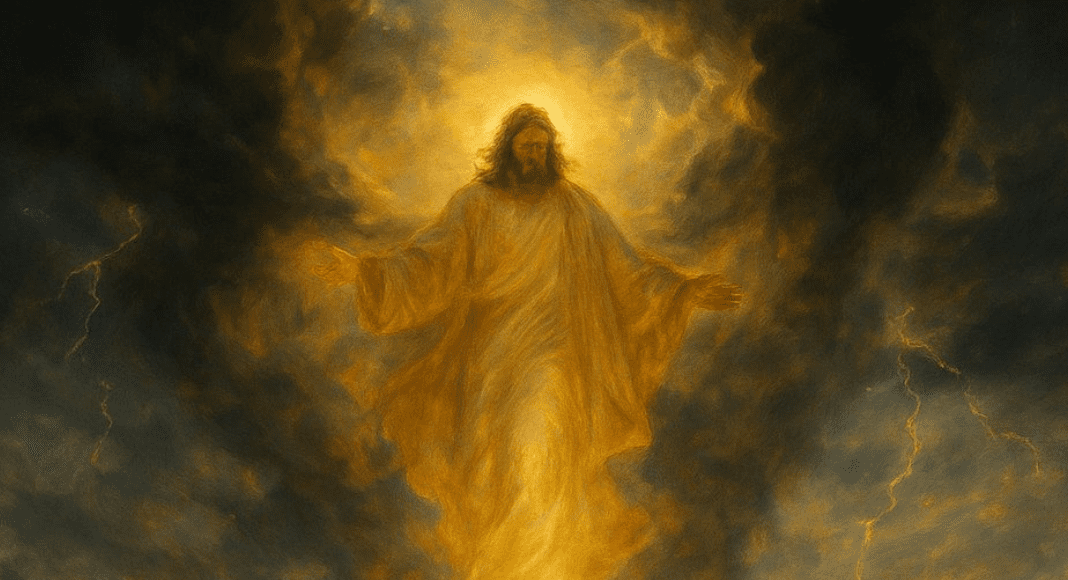
Then the moment it has all been building towards will happen. It’s captured in verse 30: “Then will appear in heaven the sign of the Son of Man, and then all the tribes of the earth will mourn, and they will see the Son of Man coming on the clouds of heaven with power and great glory” (Matt. 24:30). This is what everything has been building toward. The clouds part, and the true King appears.
When Jesus spoke those words, He was not inventing new imagery. He was reaching back into the oldest visions Israel knew. Daniel 7 saw “One like a Son of Man coming with the clouds of heaven” to the Ancient of Days, receiving dominion over every people and nation. The prophets called Yahweh the cloud-rider, the storm-rider, the One who rides on the wings of the wind. Isaiah said, “The Lord is riding on a swift cloud and comes to Egypt…” (Isaiah 19:1). Nahum called the clouds the dust beneath His feet (Nahum 1:3). To come with the clouds was to come as God Himself in judgment and rescue. So, when Jesus said He would return this way, He was claiming that mantle. The carpenter’s Son would ride in as the Lord of Heaven.
Matthew 24:30 says, “the sign of the Son of Man” will appear. We are not told exactly what that sign is. Maybe it’s the blinding glory that surrounds Him, the Shekinah light that once filled the temple. Maybe it’s simply Him — His appearing being the sign. However it unfolds, it marks the turning of the age. The heavens themselves become the stage for His coronation.
Then the mourning begins. Matthew uses a phrase from Zechariah 12: “They will look on Me whom they pierced, and they will mourn for Him” (verse 10). The Greek can mean “the tribes of the land.” The picture fits the prophets — Israel, battle-worn and broken, sees her Messiah and realizes who He is. The mourning is real, not theatrical. Families grieve apart, hearts break open and repentance flows like rain. But Revelation widens the frame — “all tribes of the earth will wail on account of Him” (Rev. 1:7). What begins in Jerusalem spreads to the world. Some mourn in repentance. Others in terror. Either way, every eye sees Him.
All of history has been laboring toward this moment. Jesus called the wars and upheavals “…the beginning of birth pains” (Matt. 24:8). The prophets called the final war around Jerusalem — birth pains. Birth pains are not meaningless agony. They are pain with a promise. And the question those contractions ask is simple — What is being born? The answer stands in the sky — the Kingdom, the reign of Christ on earth. The child of that suffering is the rule of God made visible.
Every tremor, every persecution, every darkened sun is the travail before the glory. He will appear in the air before His feet touch the Mount of Olives. The world will see before it kneels. This is not a hidden or private return. It is not symbolic. It is the visible unveiling of the true King. The armies gathered for war will look up and find the real Commander descending. The false messiah will be exposed in an instant. The great lie will collapse beneath the brightness of His coming.
The old phrase “coming on the clouds” becomes more than poetry in that light. It is movement and majesty. The same clouds that hid Israel in the wilderness now reveal her Redeemer. The same Presence that once rested above the mercy seat now rolls across the sky. The heavens shake not from destruction but from revelation. The Creator is stepping back into His creation.
The prophets saw it in fragments. Isaiah saw the heavens rolled back like a scroll. Joel saw the sun turn dark and the moon to blood. Daniel saw thrones set and judgment given. Jesus ties them all together. The regional war, the deception, the famine, the collapse — they are contractions. The appearing is the birth. Out of tribulation comes the kingdom. Out of mourning comes mercy.
For Israel, it is recognition. For the nations, it is reckoning. For creation, it is redemption. We are not watching myth but fulfillment. Geography and covenant meet on one horizon. The same land where He was lifted up on a cross will see Him lifted again in glory. The same Mount of Olives where He gave this prophecy will see His return. The same people who once said, “Crucify,” will one day cry, “Blessed is He who comes in the name of the Lord.”
Every thread of the story pulls here. The beast’s war, the false prophet’s deception, and the collapse of Babylon all bring the world to the edge of this revelation. The King is coming, first to the sky, then to the soil. Heaven invades earth not with speeches or symbols but with the presence of the risen Son of Man.
When He appears, no one will need to ask if it’s really Him. Lightning doesn’t need a caption. Glory explains itself. The birth pains end. The reign begins.
And for those who belong to Him, Luke gives the command that still holds: “When these things begin to take place, stand up and lift your heads, because your redemption is drawing near” (Luke 21:28).
