



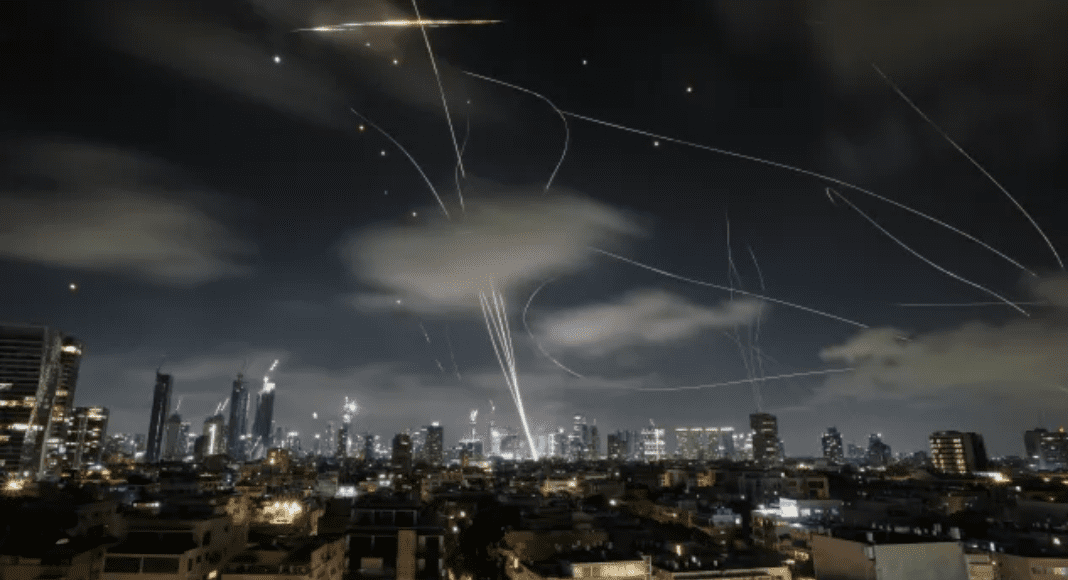
We’re taking a break from the serious about the end times being a regional conflict in the Middle East, centered in Israel, to look at the current regional conflict centered on Israel occurring right now. Irony, right?
Every time war erupts around Israel, prophecy circles light up. And for good reason. The Bible makes Israel the center of the end-time drama, and Ezekiel 38–39 outlines a massive future invasion led by a northern coalition, with Persianamed in the lineup. Persia is modern-day Iran, it’s only natural that the growing Israel-Iran conflict grabs our attention.
Is this the Gog and Magog war?
It’s a good question, and honestly, it’s a good instinct, because watching closely, testing what we see against Scripture — that’s what Jesus told us to do. Prophetic curiosity isn’t wrong — it’s essential. We should be asking. We should be wondering.
But as much as the surface facts feel like they fit, the deeper biblical context tells us — not yet.
Ezekiel gives us the details. This invasion doesn’t happen just any time. It comes “after many days” (Ezek. 38:8) — in the “latter years,” when Israel is dwelling securely. Ezekiel repeats that detail like a drumbeat — Israel is “at rest… dwelling without walls… with no bars or gates” (v. 8, 11, 14).
Today, Israel is anything but that. The very shape of the country is defined by its walls and gates. From the massive barrier in the West Bank, to the southern fortifications against Gaza, to the cutting-edge Iron Dome and David’s Sling air defense systems, Israel’s survival depends on barriers — physical, digital and military. One of the chief architects of Israel’s security fence, whom I had the privilege to hear speak while in Israel, admitted that the goal of these defenses is temporary. The plan is for them to come down — one day, when peace finally comes. But we’re not there yet.
That makes Ezekiel’s description almost impossible to apply to the present. Right now, Israel’s not dwelling securely. It’s bracing for war, surrounded by enemies and living with a siege mentality. The prophetic picture doesn’t match the current reality.
So why does this conflict still matter?
Because it’s not random. No war involving Israel is. These events are part of the prophetic puzzle. They’re laying groundwork, building pressure and setting the stage.
Here’s what Scripture reveals — the final 3½ years before Jesus’ return are marked by an all-out campaign against Israel. Daniel 11 lays it out in detail, down to the geography, the players and the maneuvers. Zechariah 12 and 14 describe a siege of Jerusalem. Revelation 11 shows Jerusalem being trampled by the nations. Ezekiel 38–39 is a portrait of that same campaign — one final push against Israel that ends with divine judgment and deliverance.
This is why Ezekiel uses “in the latter years” (38:8) — a phrase used in Daniel and other prophets to describe the final moments before the Day of the Lord. Gog’s war isn’t just a war; it’s the last war. It connects with the other passages describing the great assault on Israel at the end of the age.
So, when we see Iran (the ancient Persia) escalating tensions, we’re right to pay attention. We’re seeing the shape of prophecy without its fulfillment. We’re not in Ezekiel 38–39, but we’re moving in that direction quickly.
Another key detail Ezekiel gives us is the why behind the invasion. Gog says to himself, “I will go up against the land of unwalled villages” (38:11 ESV). He sees Israel vulnerable and defenseless. Something will have changed by then. A peace agreement? A false calm? Paul gives us a clue: “While people are saying, there is ‘peace and security,’ then sudden destruction will come…” (1 Thess. 5:3 ESV).
That phrase — peace and safety — is haunting. It means that people believe the danger has passed. Israel believes it can breathe easy. Maybe a massive agreement or a major war involving Israel will end, but that false sense of security is the bait Gog bites.
What is amazing is that when I was in Israel a couple of years ago, I met the architect of the security barrier, and he talked about it being built to be taken down in peace. That’s the hope in Israel. The current victories of Israel over the past year prove that. Gaza is nearly gutted. Hezbollah in the north has been neutralized by pagers. Now, the head of the evil terrorist serpent is being cut off in Tehran. They had been building for that attack for years.
This alone is going to leave them feeling safe, but they’re not there yet. Right now, nobody’s saying “peace and safety” in Jerusalem, not in Tehran and not in Washington. That tells us we’re not at the moment of Ezekiel 38. But that moment is coming, because Scripture says it will, and because this current war shows how fast things can change.
We tend to look at each conflict and ask, “Is this the one?” But what if the better question is, “How is this one connected to the one?” Because they all are. The wars that have come — and the wars still coming — are shaping the final scenario.
It’s an article for another day, but I believe Daniel 11 gives us the clearest details of the end-time campaign. And for that picture to emerge, something important has to happen — the fall of the Shiite empire, Iran. Right now, Iran is the most entrenched, aggressive enemy of Israel. But Daniel 11 describes a Sunni-led power struggle — a king of the north and a king of the south vying for supremacy. The Antichrist emerges from that northern theater.
That means Iran — Shiite-led Persia — has to fall first. Only then can the Sunni giants — Turkey, Egypt and Saudi Arabia — step into the vacuum and clash for dominance. We’re watching that realignment happen. The Abraham Accords, the Saudi-Israel normalization talks, the rise of Turkey’s regional ambitions — it’s all shifting.
So yes, we need to watch. We need to pay attention. We need to test everything against Scripture. But we also need to be wise. Not everything that shakes the earth is the earthquake, but it all leads toward it.
The Gog and Magog war of Ezekiel 38-39 is still coming, and so is the One who wins it.
