



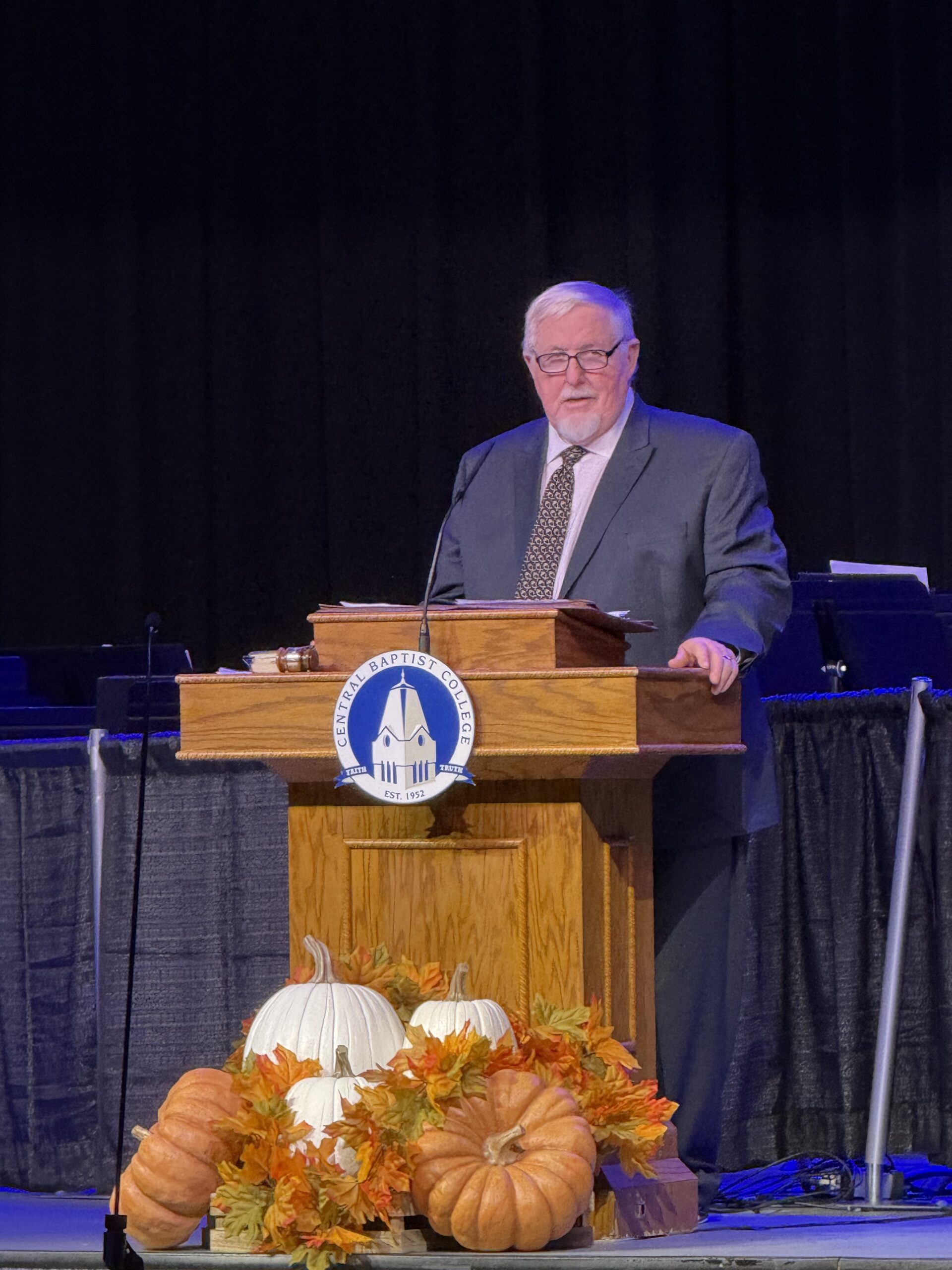
By Paul White, Executive Director • BMA of Arkansas Missions Department
Executive Editor’s Note: This is the annual message preached during the evening worship service of the 76th annual session of the BMA of Arkansas, held Nov. 6, 2025, at Central Baptist College in Conway.
Since the fall of man, humanity has wrestled with God over control. We surrender to His will, but when His reality interferes with our plans, we often climb right back off the altar. In Rom. 12:1-2, Paul bridges the deep theological truths of God’s grace with the practical realities of daily discipleship.
After spending 11 chapters explaining the mercies of God — our salvation through faith, not works — Paul writes, “I beseech you therefore, brethren, by the mercies of God, that ye present your bodies a living sacrifice, holy, acceptable unto God, which is your reasonable service” (Rom. 12:1).
This “reasonable service” isn’t a radical act — it’s the most logical, grateful response to all God has done for us. The word translated “reasonable” is the root of our English word “logical.” In light of God’s mercies, offering our lives to Him is not extreme — it’s entirely sensible.
Romans 3:20 gives us the “therefore” of condemnation — the whole world is guilty before God. Romans 5:1 brings the “therefore” of justification. Romans 8:1 gives the “therefore” of assurance. And in Romans 12:1, we come to the “therefore” of dedication.
Our reasonable service flows from gratitude, not obligation. It is an act of worship — not to gain God’s favor, but because we already have it.
A couple decided to stop by their post office one night in Memphis. The husband locked the doors and went inside. When he came back out, a gang was rocking the car — his wife was still inside.
“Lord, I need all the adrenaline I can muster,” he prayed as he ran toward the car. But before he could reach her, they knocked him down and began kicking him mercilessly. He said, “There was nothing I could do.”
Then, suddenly, an old white pickup truck came rolling up behind the car and blocked it in. The gang scattered — but not before one of them kicked him again as they ran away. The man in the truck got out, helped him up, and walked him back to his car.
“Thank you,” the man said through tears. “Thank you.”
The stranger replied, “You’re welcome at my house anytime.” He hadn’t stepped in out of obligation — but out of gratitude for what God had done in his own life.
When your life has been given back to you, the only logical response is one of deep, heartfelt thanks. That is the essence of our reasonable service to God.
Paul says we are to “present your bodies a living sacrifice.” A living sacrifice can still squirm off the altar, but when it stays, it is not because it must — it’s because it chooses to. True worship is a daily choice of surrender.
This “body” we present isn’t just our physical shell; it’s a tool in His hands, used to share God’s words of life. It requires our entire being — our talents, time, and resources offered for His purposes. “What? know ye not that your body is the temple of the Holy Ghost, which is in you, which ye have of God, and ye are not your own? For ye are bought with a price: therefore, glorify God in your body, and in your spirit, which are God’s” (I Cor. 6:19-20).
To be holy is to give your whole self to God — allowing your life to be shaped by Him for His purposes. By God’s grace, we can live lives that are well-pleasing and acceptable to Him.
Paul continues, “Do not be conformed to this world, but be transformed by the renewing of your mind” (Rom. 12:2). The world constantly tries to squeeze us into its mold, urging us to chase what is easy, popular or self-serving. But transformation begins within.
The Greek word Paul uses — metamorphoō — speaks of a radical, inner change, like a caterpillar becoming a butterfly. This is not behavior modification; it’s heart transformation. As we renew our minds through Scripture, prayer and fellowship, our thoughts begin to align with God’s will.
A missionary once told a young boy who struggled to remember his Bible reading to carry a basket to the creek and fill it with water. When the boy returned, the basket was empty, and he asked, “What’s the use?” The missionary replied, “Look how clean the basket is.” Even when we don’t remember every word we read, God’s Word still cleanses and transforms us.
When our minds are renewed, our hearts follow and our actions become the natural overflow of a transformed life. As the saying goes, what’s down in the well comes up in the bucket.
The glorious result of this transformation is that we can “prove what is that good and acceptable and perfect will of God” (Rom. 12:2). Instead of grasping for what seems right, we learn to live in God’s perfect plan — finding peace, purpose, and joy in His will.
Our reasonable service is not a burden but a privilege. In response to God’s immeasurable mercy, we offer our lives — all our thoughts, words, and deeds — as a living, holy sacrifice. Let us not offer God a half-hearted commitment, which is illogical. Instead, let us make the most reasonable decision of our lives — to live every moment in worship and service to the One who gave His all for us.
