



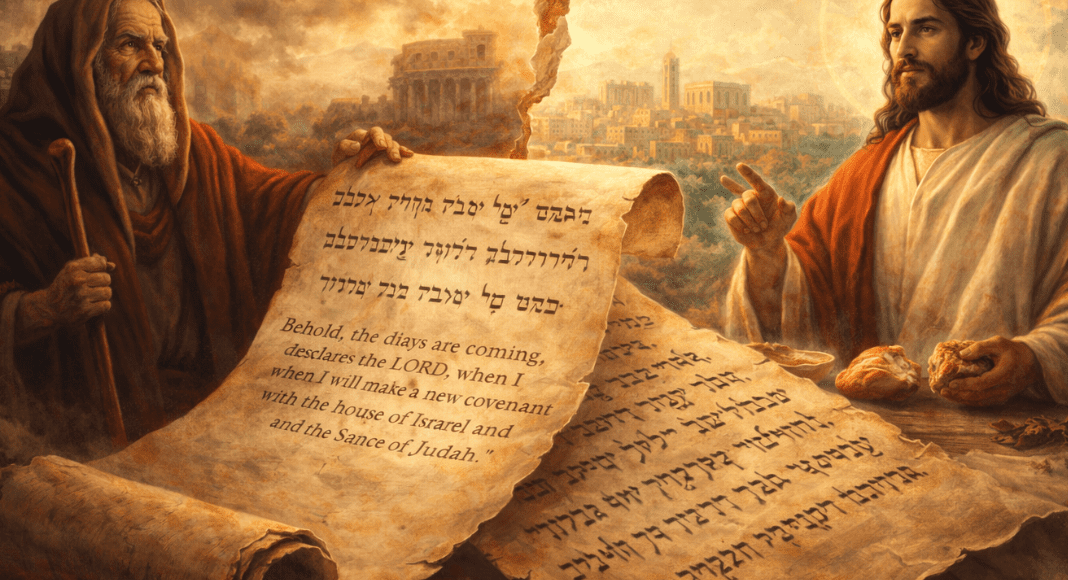
If you’ve been with me through this series, you know we haven’t played the prophecy game by the usual rules. We tossed aside charts and headlines. We refused to work backward from the news cycle or Revelation, as if the end rewrote everything that came before. We started where Jesus started — “Moses and all the Prophets.” That’s not just a clever turn of phrase; it’s a method. Law first, then Prophets, then the rest. Only then does the story make sense.
Last week, you saw just how many prophecies are loaded in the first five books. But if you pause and look deeper, you realize something even more fundamental holds it all together — the covenant backbone. Prophecy isn’t just about foretelling events — it’s about God putting His name on the line. Covenants are the engine; prophecy is the map drawn from the commitments God swore to keep.
That’s why so much end-times talk gets sideways. We try to read Daniel, Ezekiel, Matthew 24, and Revelation as if they’re stand-alone mysteries. But every prophet is standing on the same ground, building on the same story. If you want fruit, you need roots. If you want restoration, you must know what was promised, what was conditioned, and what God never backs away from, no matter how far His people run.
Moses didn’t hand Israel a bag of rules and call it a day. He gave them a structure — a covenantal framework that explained relationship, responsibility, faithfulness, and consequences. He showed how exile, regathering, judgment, and hope are not surprises, but the direct outworking of the covenants. Miss these layers, and prophecy floats like vapor. Understand them, and prophecy walks with you through history — steady, clear, anchored.
Here’s the spine — three covenants given, one promised. We already rooted the New Covenant in Jeremiah and Ezekiel, not just in tradition or assumption. But Israel’s story and the blueprint for prophecy rest on three: Abrahamic, Mosaic, and Davidic. They’re not a menu to pick from. They’re stacked, layered, and inseparable. You can’t read prophecy right until you know what’s a guarantee and what’s a conditional administration.
Start with Abraham. The prophetic storyline begins not with disaster or mystery, but with a man and a promise that refuses to die. God calls Abraham out of the background and says, “Go… I will make of you a great nation… and in you all the families of the earth shall be blessed” (Gen 12:1-3 ESV). That’s not generic encouragement — it’s the engine. God speaks of a seed, a land, and a blessing. The seed is a people and, in the end, the Messiah. The land is not an abstraction; it is real territory, contested and restored. The blessing is Israel’s calling, but always with the nations in view — God has always aimed at the world through Abraham’s line.
God seals this with His own oath. In Genesis 15, the covenant ceremony is all gravity and blood, but God alone passes through the pieces. Abraham stands aside. The weight rests on God. The Abrahamic covenant is a promise covenant: “I will do this.” When God guarantees something, history moves toward it, no matter how many times the characters fall down in the dust.
Now comes Moses — the administrator. Toomany believers treat the Mosaic covenant like the “bad old days,” as if the law was God’s failed experiment. That’s lazy thinking. The Mosaic covenant is holy, just, and governs Israel’s national life in the land. God says, “If you will indeed obey my voice and keep my covenant…” (Exodus 19:5). That “if” is no accident. Sinai is not just rules; it’s a calling to be a “kingdom of priests and a holy nation.” But it’s conditional. Deuteronomy 28 is the ledger —obedience brings blessing; rebellion brings curse and exile. The Mosaic covenant manages the enjoyment of what Abraham was promised. Abraham says, “I will give.” Moses says, “Here’s how you keep it.” Israel can be guaranteed a future and still face discipline. That’s not a contradiction. That’s how the story holds its shape.
And Moses is no fool. He knows rules alone won’t fix a hard heart. Deuteronomy 30 is the hinge — blessing, curse, scattering, return, and finally, the promise that God will change the heart. Even within the Mosaic framework, you see the need for a new covenant. That’s why the New Covenant isn’t a patch but a rescue plan, named and shaped by God before Israel ever began to fall apart.
Now the King. The Davidic covenant brings the crown into focus. Kingship was always in the plan — Genesis 49 hints at Judah’s scepter, Deuteronomy 17 gives kingly laws, but the heart comes in 2 Samuel 7. God promises David a house, dynasty, kingdom, throne — forever. “Forever” is not just a metaphor for a long time. It is covenant. God’s steadfast love will not depart as it did from Saul. The prophets are obsessed with the King, because God put the King at the center of His promises — a righteous ruler whose reign outlasts failure, death, and history itself.
So now, see the backbone: Abrahamic — seed, land, blessing, the nations, guaranteed by God’s own word. Mosaic — conditional governance, blessing and curse, exile, and always the hope of a new heart. Davidic — an enduring dynasty, a kingdom, a throne, a coming King who does not fail. Then the promised New Covenant — cleansing, forgiveness, a new heart, the Spirit within, and God’s people finally walking as they were meant to. Prophecy isn’t random. It’s God’s determination to fulfill His own spine in history.
Read the Prophets and you’ll see exile, regathering, renewal, a Davidic King, nations streaming in, peace, and God dwelling among His people. You’re not reading disconnected riddles. You’re seeing the backbone Moses gave, pulled tight and brought to life.
This is what steadies prophecy — not hype, not fear, not this week’s headlines, but covenant. The backbone holds, even when the world feels like it’s breaking apart.
Next time, we tackle the question most systems flatten or dodge: how does the New Covenant relate to these three? If it replaces anything, it’s the Mosaic administration — not the promises. Abraham and David stand. The New Covenant empowers a faithful people — believing Israel and grafted-in Gentiles — to finally live the story God promised, under the King God promised, in the world God promised, no longer chained to the old patterns of failure.
Prophecy doesn’t start at the end of the Bible. It starts in Moses.
If Jesus began there, so do we.
