



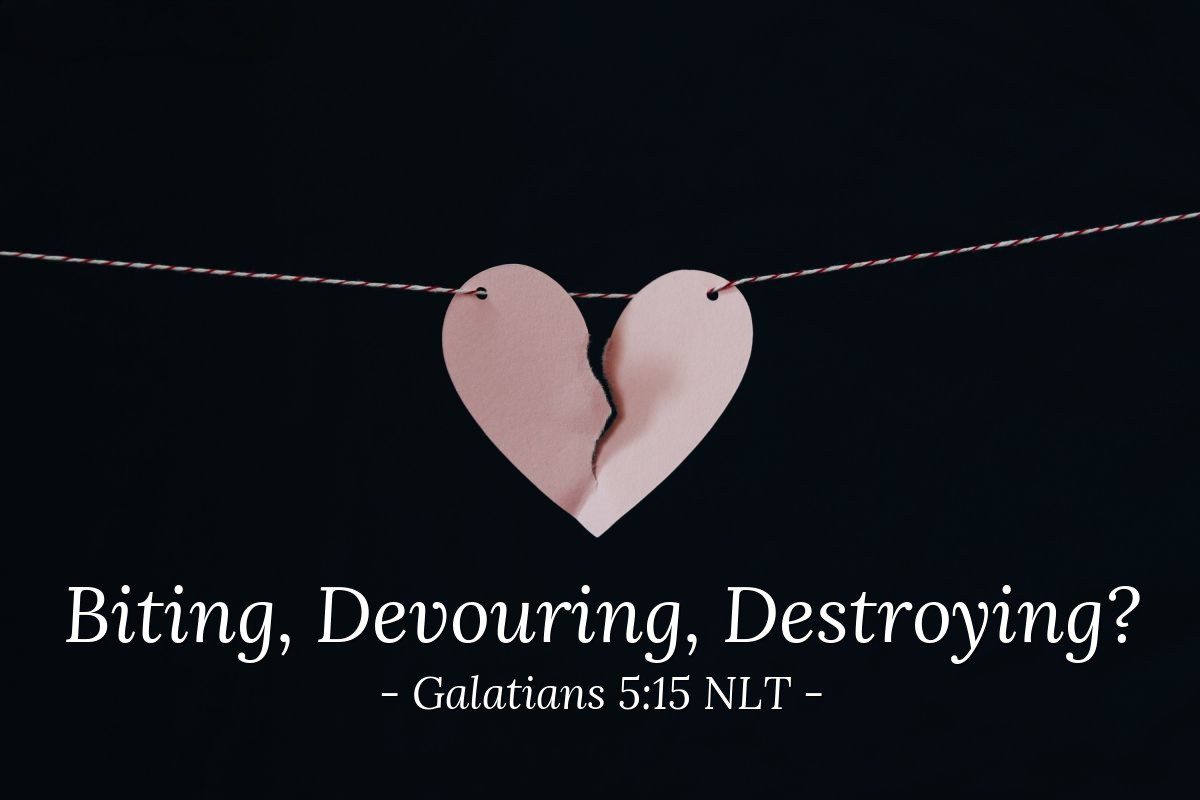
There are those who build their identity by tearing others down. Sometimes this comes through public mockery. Sometimes it wears the respectable clothes of “discernment.” Other times, it is more subtle, casting doubt, questioning motives, or poisoning the confidence of fellow servants in Christ.
Our human nature runs towards camps of identity and methodological fault lines. The categories may change, but the posture remains the same as brotherhood gives way to camps. Why do we allow nuance to be replaced with suspicion? When did differences become a point of deficiency?
This should alarm us.
There is a Time to Fight
Scripture does not call us to cowardice. There is a time to contend. Paul’s letter to the churches of Galatia leaves no room for doctrinal indifference. When the gospel itself is threatened, our firmness is no longer optional. But Galatians also reminds us that truth is not defended by devouring one another. Paul warned that “if ye bite and devour one another, take heed that ye be not consumed one of another” (Gal. 5:15).
The tragedy that plagues many today stems from confusing aggression with courage.
I’ve wrestled with this personally. Most of my friends growing up placed a lot of their identity in playing sports. While I enjoyed the arena, I didn’t like playing. There wasn’t any security in physical dominance or displays of strength for me. My childhood taught me that raw power could be cruel. Instead, I was drawn to composure, clarity, and beauty. My heart pursued things that were worthy of wonder rather than fear.
That difference cost me understanding. Immaturity often mocks what it doesn’t understand. I endured ridicule. I was often mislabeled. I learned that sharpness, readiness, and the willingness to fight were currencies that purchased a measure of respect. Over time, that lesson can harden into instinct.
When we live that way, we live at the precipice of danger. What may have once been a survival mechanism can become a governing disposition.
That Time isn’t as Common as we Think
A man who has built a habit of fighting to be seen will often keep fighting long after the threat is gone. He will mistake combativeness for conviction. He will assume that strength must always look like force. He will start to measure his faithfulness by how effectively he can dismantle others.
That’s not wisdom. That’s not maturity. And that is certainly not harmless.
The church does not need more scorched-earth theologians or sarcastic social-media pastors. We do not need men whose sharpest skill is identifying what is wrong with everyone else. The testimony of our churches suffers when our loudest voices are known more for suspicion than shepherding.
Our critiques shouldn’t subvert our care for one another. Timothy was instructed that “the servant of the Lord must not strive; but be gentle unto all men, apt to teach, patient” (2 Tim. 2:24). It has been said that gentleness is strength under discipline. Our call demands that we wield truth with love. This prevents us from holding a weapon and puts us in the posture of a physician presenting a remedy.
Our Baptist forefathers contended fiercely for doctrine while maintaining deep commitments to cooperation, missions, and mutual encouragement. They understood that unity doesn’t demand uniformity. Have we forgotten that disagreement does not require disdain? We dishonor that legacy when we reduce our brotherhood to a battlefield.
There will be times when we must stand firm. More often than not, our pressing call is to stand beside one another even when we don’t stand exactly alike.
We’re a Peculiar People
The world already knows how to fight. What it rarely sees is a people who can disagree without devouring, who can contend without contempt, who can hold convictions without losing charity.
When I observe myself and others who are quick to tear others down, it is easy to see loud confidence. The downside is that we are rarely as precise as we ought to be. Positions never really get articulated because they are propelled into existence by reactions.
If you listen to someone whose language is always negative, they are defined by what they are against. “Not that,” “Never that,” “Anything but that,” they say. Their theology becomes a series of fences rather than a house fit to live in. Their ministry philosophy is clearer in its denunciations than in its affirmations.
At some point, this becomes spiritually telling.
It is easier to criticize than it is to confess. Negation requires less maturity than construction. Most of us know what we stand against while struggling to articulate what we believe or why it is good, beautiful, and worthy of trust.
The gospel doesn’t work this way.
Jesus diagnoses our condition with terrifying clarity. He names our sins. He exposes our bondage. He does not soften the reality of the fall. But He never stops there. Condemnation is not His final word because the gospel is about redemption. Exposure opens the door to an invitation. The gospel speaks truthfully about what we are not so that it may proclaim, with greater force, what we may yet be in Him.
Any ministry perpetually defined by negation eventually starves its own people. Sheep cannot live on warnings alone. They must be fed. They must be led into green pastures, not merely kept away from poisonous ones. When pastors speak only in the negative, they produce congregations that are fearful, suspicious, and brittle.
Clarity that never reaches confession is not clarity at all. It is a reactive posture pretending to be conviction.
We Need Clarity Brought Forward with Charity
We must learn again to say what we are. We are gospel men and women. We are committed to Scripture as our final authority. We believe in repentance that leads to life, sanctification that is patient and real, evangelism that is faithful and sincere, and discipleship that is intentional and relational. We believe truth should be spoken plainly and carried gently. We believe faithfulness is measured by what we lovingly and persistently build.
This takes courage. It risks misunderstanding. It demands patience. But it reflects the heart of Christ far more faithfully than endless critique ever could.
If the gospel we preach ends in redemption, then the ministries we lead should sound like hope. The church does not need more men skilled at pointing out what is wrong. It needs more shepherds who can name sin honestly and lead people confidently toward grace.
That is a strength. And that is the greener pasture worth seeking.
