



Over the past few articles, we’ve traced the covenant spine — and you can feel the shift. We didn’t start with Revelation. We didn’t start with Rome. We didn’t start with beasts, headlines, and timelines. We started where Jesus started — Moses, then the Prophets, then everything else. Not because that sounds traditional. Because that’s the method He gave.
And when you start there — when you actually let the Law speak before you rush to the end — you begin to see something that most Christians never slow down long enough to notice. The covenants are not side notes. They are the backbone. They are the engine under prophecy. They are the reason the future is not chaos.
Abraham. Moses. David. And the promised New Covenant. Not four disconnected theological categories, but one covenant spine moving history toward something real.
In the last article, we made it plain: the New Covenant does not cancel the story. It powers the story. It replaces the Mosaic administration as the governing mechanism, not because God lowered the standard, but because God finally does heart surgery. The old covenant commanded. The New Covenant transforms. The Law demanded faithfulness. The New Covenant produces it.
But here’s the question we must ask if we’re going to finish this honestly: where is all of this actually going?
The answer the prophets give is not vague. It is not sentimental. It is not merely “saved people going somewhere better.”
The covenants aim at the age to come.
Jeremiah does not blush when he says the New Covenant is made with the house of Israel and the house of Judah. Ezekiel does not shrink when he speaks of regathering, cleansing, and a Davidic ruler reigning over a restored people. The language is national. Covenantal. Concrete. “My servant David shall be king over them…” (Ez. 37:24 ESV). That’s not abstraction. That’s throne language.
And here is where many readers panic and start trimming verses until they fit their system. If the promises are to Israel, what do we do with that? If restoration is described in land terms, what do we do with that? If the King is described as reigning, what do we do with that?
We do what Jesus did. We refuse to skip Moses.
The Abrahamic covenant promised seed, land, and blessing to the nations. The Mosaic covenant governed Israel’s life in that land under blessing and curse. The Davidic covenant guaranteed a throne and a forever King. The New Covenant promised heart change and Spirit empowerment so the people would not repeat the cycle of exile again.
None of those promises dissolve into thin air at the cross. The cross secures them.
And Gentiles? They are not an afterthought. They were always in view. God told Abraham, “…in you all the families of the earth shall be blessed” (Gen. 12:3). That was Genesis, not Romans. The nations were baked into the promise from the beginning. But they are brought in through Abraham’s Seed. They are grafted in. Included in the story, not replacing it.
That means you cannot read restoration passages and delete Israel. And you cannot read inclusion passages and delete the nations. The covenants demand both.
Now step back and look at the architecture.
If the Mosaic covenant was conditional — blessing for obedience, curse for rebellion — then exile made sense. Israel’s history proves the point. But Moses himself anticipated more. He spoke of scattering and return. He hinted at heart circumcision. Even within the Law, you can feel the forward lean.
The New Covenant answers that question caused by the lean.
It creates a people capable of covenant loyalty. It writes the Law on the heart. It puts the Spirit within. It causes obedience. Not perfection in a vacuum. Faithfulness under a King.
And that matters because a righteous King ruling over a rebellious people is not stability. It’s just the Old Testament again. The New Covenant creates citizens fit for the reign of the King promised to David.
So, when the prophets speak of regathering, of peace, of nations coming, of a Davidic ruler reigning, they are not writing mystical poetry detached from reality. They are describing covenant fulfillment in history.
Call it millennial if you want to use the New Testament frame. Call it a messianic reign if you want to use the prophetic one. But if the covenants are real, then their fulfillment is not vapor. A throne means reign. A land means dwelling. A promise to the nations means inclusion. A covenant of peace means stability under God’s presence.
And yet the story does not end there.
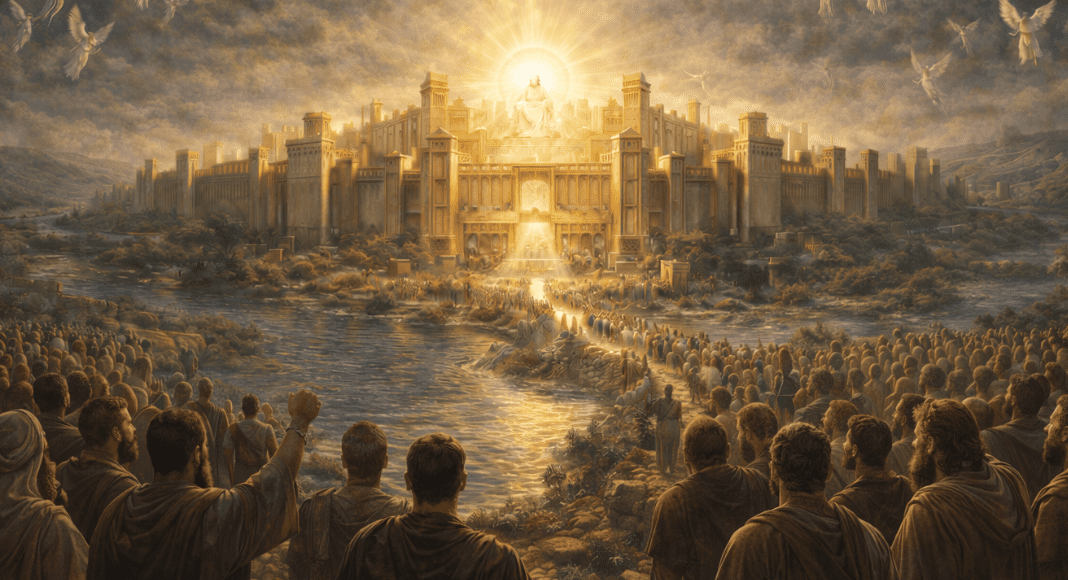
The Bible does not close in a palace. It closes in a garden-city. Revelation returns you to Eden imagery — tree of life, river of life, no curse, God dwelling with His people. The nations are there. The curse is gone. The ground is healed. The separation that began in Genesis is undone.
That is not escapism. That is restoration.
The covenants move you from promise, to discipline, to renewal, to kingdom, to new creation. They begin with seed, land, and blessing. They culminate in a world where blessing is permanent, the King reigns without rebellion, the nations worship, and God dwells with His people without interruption.
That is Eden reclaimed.
Both Jew and Gentile on an Edenic earth, God dwelling with us again, walking among His people as in the cool of the day.
And that is why prophecy is not Christian fortune-telling. It is covenant fulfillment. It is God keeping His word across centuries of failure, exile, return, blood, and resurrection.
When Jesus told His disciples to begin with Moses, He was not offering a clever Bible study tip. He was handing them the map. Start with what God promised. Start with what God conditioned. Start with what God swore. Then read the prophets. Then read the Gospels. Then read Revelation. And you will see not chaos, but convergence.
Abraham explains the blessing. Moses explains the exile and the need for heart change. David explains the King. The New Covenant explains the Spirit-empowered people. The age to come explains the reign. The new earth explains the permanence.
Prophecy does not begin at the end of the Book.
It begins where God put His name on the line.
In Moses.
And if Jesus started there, we will too.
