



By Larry Page, Executive Director • Arkansas Faith & Ethics Council
Executive Editor’s Note: For more details about the recent IRS decision discussed in this article, see the article from The Christian Post titled, “Pastors Endorsing Political Candidates Doesn’t Violate Law,” that appeared on page 4 of last week’s Baptist Trumpet.
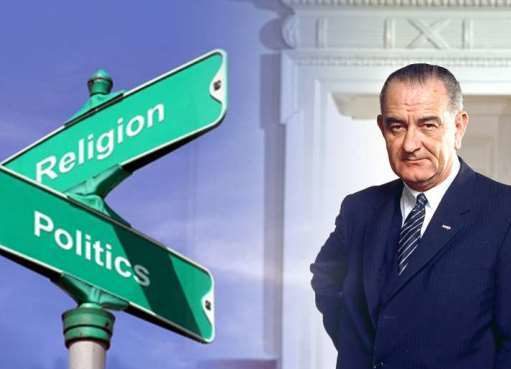
For 71 years, churches and their pastors and leaders have felt the need to tread lightly when speaking about political matters in their official capacities as leaders and spokesmen for their churches. A 1954 amendment to the U.S. Internal Revenue Code, commonly referred to as the “Johnson Amendment,” has served to chill the free speech of churchmen.
Without getting into the legal weeds too far, the Johnson Amendment prohibited 501(c)(3) tax-exempt organizations, which include religious nonprofits and churches, from directly or indirectly participating in, or intervening in, any political campaign on behalf of (or in opposition to) any candidate for public office.” That is considered partisan political activity and was what the Johnson Amendment was intended to prohibit.
Simply put, this would restrain a pastor or other church leader from expressing his support for or opposition to a candidate for public office from the pulpit or in a newsletter or other church correspondence. However, the ban would not prevent the pastor or leader from holding and expressing such sentiments as a private citizen, as any other individual holds the right to do.
By all accounts, that seems to be an absolute prohibition — one that might be expected to have had to be enforced numerous times, given the many open and flagrant violations of the restriction by countless pastors and church leaders over the years. Those who have defied the IRS and the Johnson Amendment run the whole gamut of churches and other nonprofits; from the most liberal to the most conservative and at all ideological points in between those extremes.
Yet the IRS has declined for years to attempt to sanction churches for going outside these boundaries established by the Johnson Amendment for obvious reasons. A number of constitutional lawyers and scholars have opined that any efforts to enforce the Johnson Amendment against a church would be found by the courts to be a clear infringement of the pastor’s or church leader’s First Amendment rights to freedom of speech and freedom of religion.
In the latest development, the IRS has reinterpreted the Johnson Amendment. In 2024, two Texas churches and a national broadcaster joined as plaintiffs, suing the IRS, alleging that enforcement of the Johnson Amendment would circumvent their First Amendment rights to free speech and religious liberty. With the challenge reaching the courts and an impending decision that would not be in their favor, the IRS chose to collaborate with the plaintiffs, resulting in a settlement agreement that became a consent judgment approved by the court.
The consent judgment, as described by Baptist Press, “allows churches not only to address congregations from the pulpit when their religious beliefs compel them to take a position on electoral politics, but also to address congregations through customary communication channels, including published or distributed statements. In doing so, churches ‘neither “participate(s)” nor “intervene(s)” in a “political campaign, within the ordinary meaning of those words.”
What now? How should churches, their pastors and leaders react to this development? Now that the IRS has said that endorsing or opposing candidates from the pulpit is permissible, does that in and of itself make it appropriate?
Should the pulpit be a platform from which both the gospel of Jesus Christ is proclaimed and a campaign spiel endorsing or opposing a candidate for political office is expressed? Can the latter serve to sully the former? Depends on who you ask.
Response to the Johnson Amendment
Included here are some responses from pastors, other stakeholders in faith-based organizations and other interested parties. The views are sharply divergent, reflecting both perceived nuances and biases. For the sake of brevity, we have provided just a few examples of the responses:
• Clint Pressley, president of the Southern Baptist Convention, stated that the change “recognizes our freedom of speech and should encourage pastors all the more to preach the Bible clearly, courageously, and convictionally.”
• Rachel Laser of Americans United for Separation of Church and State said, “Weakening this law would undermine houses of worship and nonprofits by transforming them into political action committees…”
• Mike Mullins of the Ethics and Religious Liberty Commission opined that “like other citizens, church leaders can exercise their First Amendment rights without fear…”
• Cal Thomas, a noted editorial writer on faith-based issues, said that “Politicians and preachers should mostly stay in their own lanes. Where Scripture speaks clearly to a contemporary issue… I’m ready to listen. But don’t let me hear who the pastor prefers in the next election.”
• Tony Perkins of the Family Research Council said, “After years of education, agitation and the efforts of many, churches will now be unshackled from the Johnson Amendment — free to speak biblically on cultural issues and candidates.”
• David Johnson, the executive director of the Arizona Mission Network of Southern Baptists, shared that “…a pastor who steers clear of political affiliation can speak more powerfully to their community on issues of moral and ethical import…. I believe it will also enable them to have a stronger witness for the gospel to those who may not have the same political views… while the reinterpretation of the Johnson Amendment makes it permissible for pastors and churches to express political preferences, we should exercise caution before doing so for the sake of the gospel.”
Now for my take. At the 2023 Arkansas Baptist State Convention’s annual meeting, I addressed this very issue with that gathering. I will summarize the points I discussed in the meeting.
First, a few caveats. The position I have on this issue is at odds with what some people I respect and pay attention to have concluded. It is simply a matter of reasonable, serious-minded individuals finding different solutions to a multifaceted issue, one not given to a simple black-and-white dichotomy. Could I be wrong? Of course, I could. But in this matter, I think I am correct.
Secondly, pastors have always been free in the pulpit to address moral and cultural issues that the Bible speaks to — whether explicitly or implicitly — to attempt to influence what their congregation thinks about those issues.
And third, pastors have always been able to express their political views of all sorts, including preferences for political candidates and parties, as private citizens and not when serving in a formal role, such as preaching or writing a church newsletter or otherwise being a spokesman for the church.
In my 2023 Baptist convention address, I asked the question, “Is it wise for a pastor to endorse or oppose a political candidate or party in his formal role as pastor, leader and representative of his church?” I answered my own question, saying, “I think not.”
I added that, “We should never conflate the right to do something with the propriety of doing that thing.” The apostle Paul instructed believers to refrain from doing something that they had the right to do if it might hurt another. It is a matter of license (I have the right to do this thing) versus liberty (I will not do what I have the right to do out of consideration for the harm it might cause another).
My overarching concern was, and still is, to maintain the holy and pristine status of the pulpit. Rather than putting an emphasis on endorsing or opposing a political candidate or party in the pulpit, perhaps the pastor should simply preach the Word, proclaim the Truth, apply biblical principles to the issues of the day and trust members of their congregations to make wise decisions as responsible citizens. If any member wants to know his preferences regarding political candidates or parties, they can ask him, and he can share his opinions if he chooses, in less formal settings, as any private citizen has the right to do.
That is the proper use of the pulpit — and of that I am firmly convinced. To do anything that would make it seem less lofty, more secular, more temporal, enervated and impotent, I fear, would serve as a great disservice to the kingdom. And that would be a shame.
